
The portfolio review showed plenty of activity. The management team had reported progress against the value creation plan. Pricing actions were underway. Procurement savings had been identified. Inventory remained above target, but several improvement efforts were in progress.
Yet the expected movement in EBITDA and cash had not followed.
At that point, the conversation changes. Are the original value creation assumptions still valid? Have the savings actually been captured, or simply calculated? Is inventory itself the problem, or is it the financial result of deeper operating constraints? Does the management team need more time, a focused intervention, or additional leadership capacity?
The company has a plan. The question is whether that plan still reflects the operating reality of the business and its ability to deliver the expected results.
At NEXT LEVEL Partners, we refer to this lifecycle approach as Value Creation by Design: an operating playbook that helps private equity firms and portfolio company leaders identify, capture, and sustain value throughout the hold period.
It is grounded in the practical work of translating value creation assumptions into operating results alongside sponsors and management teams.
This article introduces the framework and the role operational execution plays throughout the private equity hold. In the months ahead, we will continue exploring the critical points within that lifecycle, including operational due diligence, the first 100 days, the mid-hold reset, late-hold value creation, and the leadership and operating capabilities required to turn an investment thesis into measurable results.
From Investment Thesis to Operating Plan
Private equity firms are highly skilled at evaluating markets, assessing management teams, constructing financial models, and identifying where value may exist. Capturing that value requires an equally clear understanding of how the business operates and whether the organization has the ability to execute.
A model may identify margin expansion, working capital improvement, pricing, productivity, or growth as important value levers. Delivering against those opportunities requires understanding the processes, decisions, leadership capabilities, and operating constraints behind the financial results.
A complete view of value creation requires three forms of visibility:
- Financial visibility explains what is happening in the results.
- Operational visibility reveals the processes, decisions, behaviors, and constraints producing those results.
- Execution visibility shows whether the organization has the leadership, capability, discipline, and operating cadence required to capture the opportunity.
For example, a model may indicate that inventory can be reduced. Operational visibility reveals why the inventory exists. Execution visibility determines whether the organization can change the underlying conditions without compromising service or growth.
A strong value creation playbook connects all three.
A Lifecycle Approach to Value Creation
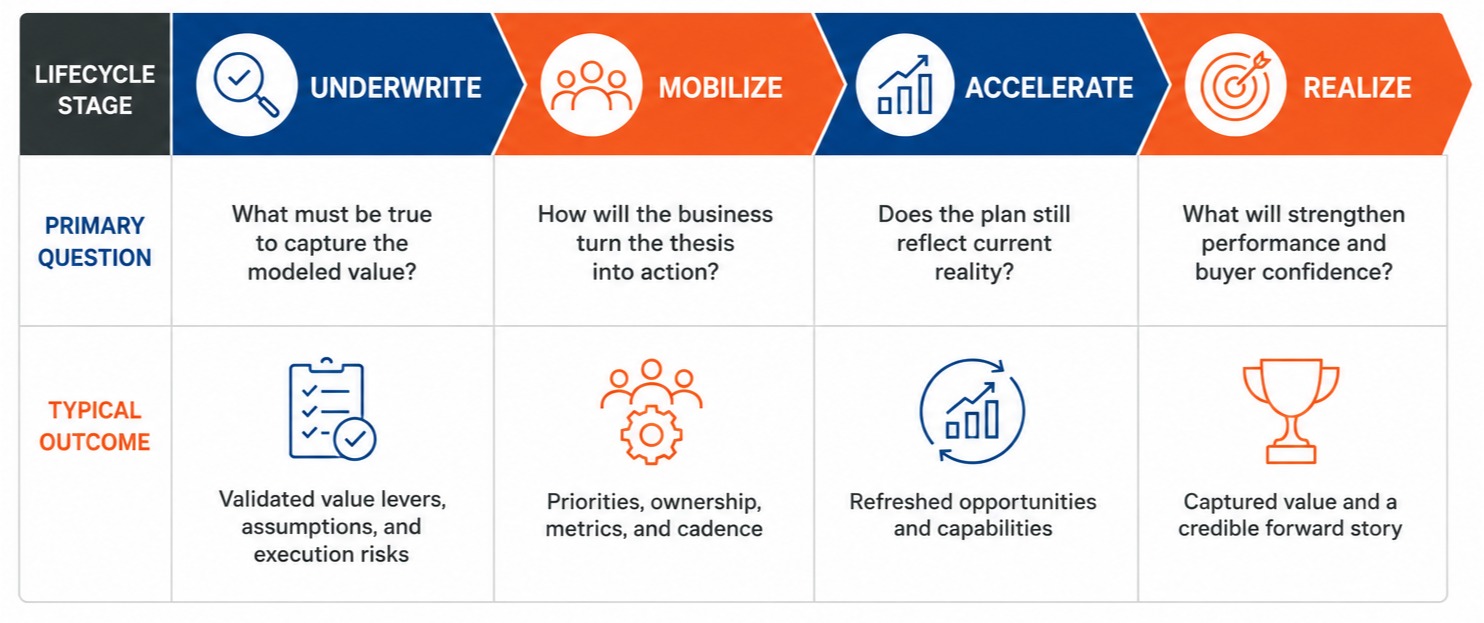
The needs of a portfolio company evolve throughout the hold. A practical value creation lifecycle can be organized around four stages:
Underwrite. Mobilize. Accelerate. Realize.
Each stage requires a different emphasis, but the objective remains consistent: turn identified opportunity into captured and sustainable value.
Underwrite: Validate the Opportunity and the Risk
During due diligence, one operating question should remain front and center: What must be true for the modeled value to be captured?
The data room, financial statements, market analysis, and management presentations establish the financial and commercial foundation. Firsthand observation provides another critical layer by helping explain the operating conditions behind those results.
Visiting the business, speaking with leaders, reviewing operating metrics, and examining how work actually flows can test the assumptions in the model and connect financial diligence with operating judgment.
A disciplined operating assessment should help:
- Validate the most important value levers and underlying assumptions
- Separate structural opportunities from temporary noise
- Identify operating, leadership, and execution risks
- Distinguish potential savings from benefits that can realistically be captured
Opportunities can then be organized across direct cost, quality, operating expense, cash, capacity, commercial performance, and indirect benefits. The assessment should also determine whether the company has the leadership capacity and operating discipline required to capture the opportunity. Identifying value is only the beginning. The organization must be capable of executing against it.
Mobilize: Convert the Thesis Into Action
Once the transaction closes, the first 100 days bring urgency, new reporting expectations, and pressure to demonstrate momentum. An effective 100-day plan creates a system for execution around the few value levers that matter most. Each priority should connect to a measurable outcome, accountable ownership, clear milestones, and a regular review cadence.
That may include:
- Translating the investment thesis into a focused set of operating priorities
- Establishing targets, ownership, and decision rights
- Creating a disciplined review cadence
- Launching focused improvement efforts
- Addressing leadership and capability gaps
- Building mechanisms to sustain gains
For some businesses, the immediate need is improvement. For others, stability must come first. Missed customer commitments, liquidity pressure, leadership turnover, quality failures, or weak day-to-day control may require interim leadership or a turnaround team to restore priorities, accountability, and operating control. Under those conditions, stabilization becomes the first value creation priority.
Accelerate: Reassess the Plan at Mid-Hold
The middle of the hold period is often treated primarily as an execution phase, with attention focused on tracking progress against the existing plan. By years two or three, that plan deserves a deliberate reassessment.
The company may have grown, completed acquisitions, entered new markets, changed leaders, or developed constraints that were not present at acquisition. Some original opportunities may have been captured, while others have stalled or produced local improvements without delivering the expected financial impact.
A mid-hold reassessment should ask:
- Which opportunities have actually reached the income statement or balance sheet?
- Which savings have been captured, and which have only been identified?
- What has changed since the original value creation plan was developed?
- Are current priorities still tied to the most important value levers?
- Does the leadership team have the capacity required for the next phase?
This is often where a refreshed operating perspective becomes especially valuable. A specific constraint involving inventory, cash, throughput, quality, labor productivity, or cost may call for a focused intervention. Recurring performance gaps, emerging bottlenecks, conflicting priorities, or dependence on a few individuals may point to the need for broader management-system improvement.
Leadership needs also become clearer at mid-hold. The business may require interim leadership to provide immediate operating capacity, a turnaround leader to restore stability under pressure, or a permanent executive equipped to scale the company through its next stage. Talent decisions create the greatest value when they are grounded in a clear understanding of what the business needs next.
Realize: Strengthen Performance and Exit Readiness
Late in the hold period, the sponsor may face EBITDA below plan, weaker cash generation, a less receptive market, or a multiple that falls short of the original expectation. Attention naturally shifts toward the remaining sources of value. Late-hold improvement should strengthen current earnings while increasing confidence in future performance. Prospective buyers will evaluate the results being delivered and the organization’s ability to sustain them.
Late-hold value creation therefore has two related objectives:
- Capture remaining EBITDA and cash opportunities.
- Demonstrate that performance is repeatable and sustainable.
A specific and measurable constraint may call for targeted improvement in inventory, scrap, throughput, procurement, labor productivity, quality, or working capital. Interconnected problems, gains that have not held, or performance that depends too heavily on a few individuals may require broader changes in leadership routines, accountability, metrics, problem-solving, and daily execution.
The objective is to strengthen performance, operating credibility, and the forward value creation story presented to potential buyers.
Stabilize, Target, or Transform
At every stage of the hold, the appropriate intervention depends on what is constraining value capture. Three levels provide a practical framework for determining what the business needs next.
Stabilize
Stabilization is appropriate when the organization lacks operating control, leadership capacity, or clarity.
The immediate objective is to restore visibility, accountability, and reliable execution. This may include interim leadership, turnaround support, focused cash management, or rapid attention to customer, quality, and delivery problems.
Target
A targeted intervention is appropriate when the constraint is specific, measurable, and contained.
Excessive inventory, weak throughput, poor labor productivity, high scrap, long setup times, working capital pressure, or a defined EBITDA gap may call for a focused Kaizen event or Practitioner-led effort that concentrates resources on a specific source of value.
Transform
Transformation is appropriate when issues are recurring, cross-functional, or rooted in the way the business is managed.
Repeated problems, conflicting priorities, misaligned metrics, and reactive leadership routines may require a broader business-system approach connecting strategy, operating priorities, leadership behavior, problem solving, metrics, and daily execution.
From Identified Opportunity to Captured Value
The needs of a portfolio company will change throughout the hold, but the critical questions remain remarkably consistent:
- Which value levers matter now?
- What is constraining their capture?
- Does the company need greater stability, a focused intervention, or a broader business-system approach?
Answering those questions requires financial, operational, and execution visibility.
Value is captured when firms identify the right levers, understand what is standing in the way, build the capability to act, and manage execution with discipline and intent.
That is Value Creation by Design.
As NEXT LEVEL Partners continues the conversation around private equity value creation, future articles will examine these critical moments in greater depth and share practical perspectives for sponsors and portfolio company leaders working to turn identified opportunity into sustainable performance.
Have a question, perspective, or value creation challenge your organization is working through? Reach out, our leadership team welcomes the opportunity to compare perspectives and discuss what may be standing between identified opportunity and captured value.