

By the middle of a private equity hold, the portfolio company is no longer the business described in the confidential information memorandum. Several years of operating experience have replaced many of the assumptions that existed at close.
The sponsor and management team have worked through planning cycles, missed forecasts, capital decisions, customer issues and leadership challenges. Some initiatives have created meaningful value while others stalled. Customers, markets and constraints may also have changed.
That makes mid-hold a natural point to ask the question:
Is the original value creation plan still the right plan for the business that exists today?
This question can get lost in the regular cadence of board meetings and operating reviews. It matters when a company is struggling, but it also matters when performance appears acceptable. A business can improve steadily while still falling short of the pace or potential envisioned at close. Good performance can create complacency if leaders stop challenging whether the business is realizing its full opportunity.
Why Portfolio Companies Need a Mid-Hold Reset
Mid-hold is different because both sides are farther down the learning curve. Due diligence can reveal a great deal, but some realities only emerge after operating the business together. By the second or third year, there should be better evidence about management credibility, execution capability, culture and the assumptions behind the original deal.
That evidence should elevate the discussion beyond whether individual initiatives are on track. Leaders should ask whether the original sources of value remain relevant, whether the organization can capture them and whether new constraints have emerged.
Common signals that a reset may be warranted include:
- Financial performance repeatedly falls short of plan, even as local operating metrics improve.
- The same problems return in operating reviews month after month.
- Major initiatives consume management attention without producing visible economic benefit.
- Leadership turnover increases or critical roles remain unresolved.
- Capital requests continue resurfacing because the underlying constraint was never addressed.
Consistently acceptable performance can also be a trigger. Mid-hold should create enough healthy tension to challenge both persistent underperformance and comfortable incrementalism. It is the point where operating experience begins to catch up with the investment thesis.
Revisit the Original Investment Thesis
A useful reset begins by returning to the original expectations for the deal. Pull out the CIM, investment thesis, value creation plan and assumptions behind the financial model. Revisit the growth expectations, margin opportunities, working capital improvements, productivity assumptions, pricing opportunities and other sources of value that supported the investment.
Two or three years into the hold, the team has enough evidence to test those expectations against reality:
- Which assumptions proved correct?
- Which opportunities were captured, and which improvements never reached the financial statements?
- Which initiatives did not happen or failed to produce the expected result?
- Which expectations were too ambitious?
- What changed in the market, competitive environment or operating model?
This review can be uncomfortable, but its purpose is learning and accountability. The original thesis should be treated as evidence, not ammunition. Once the lessons are clear, the discussion should turn forward and build a plan around what the team now knows.
The reset should be jointly led by ownership and portfolio company leadership, with the board ensuring that difficult questions are answered and decisions are made. Independent challenge can also help surface assumptions that both sides have become comfortable with.
Re-Establish Current Financial and Operating Reality
The mid-hold review should bring some of the rigor of the original diligence process to the business as it operates today.
Start with financial reality. What value has actually reached revenue, EBITDA, cash flow and the balance sheet? Operational teams may point to completed projects and claimed savings, but the test is whether those improvements changed the economics of the business.
Trace each improvement from activity to operating result to financial realization:
- A productivity gain should increase capacity, reduce cost, improve service or support growth.
- Headcount avoidance creates value only when the avoided cost was genuinely required.
- Inventory reduction matters when it releases cash without degrading service.
- Pricing improvement matters when it survives changes in volume, mix and customer retention.
Then examine operating reality. What do delivery, quality, inventory, lead time, productivity, capacity, customer and growth measures reveal? Where are the constraints today?
Return to where the work happens. A dashboard can describe a problem without explaining it. Direct observation connects the numbers to the way work actually flows through the business.
One company we worked with carried approximately $28 million of finished goods inventory while delivering only about 83 percent of orders on time. The business had inventory, yet customers were still waiting. That contradiction pointed to a deeper problem in flow and lead time.
The organization focused its improvement work on those constraints. Finished goods inventory eventually declined by roughly $11 million while on-time delivery climbed into the upper 98 percent range.
The lesson was broader than the methods used. Most organizations will always have projects underway. The more useful question is whether those efforts target the few levers capable of materially changing business performance.
Assess Operating Capability and Leadership
Mid-hold also provides evidence that could not exist during diligence: whether the company has become more capable. A strong operating playbook should improve the organization’s ability to think, adapt, experiment, solve problems and execute.
That capability should be visible in the way the business operates:
- Strategic plans and budgets are better connected to operating reality.
- Operating reviews expose problems early and lead to meaningful countermeasures.
- Teams distinguish root causes from symptoms and solve problems closer to the work.
- Leaders consistently reinforce the priorities and behaviors they say matter.
- The organization identifies constraints, allocates resources, learns from results and adjusts course more effectively.
Talent and culture also become easier to assess with time. Retention, turnover and leadership behavior reveal whether alignment is embedded in the organization or visible only when senior leaders are present.
The starting point should remain the process and the system. Over time, however, the evidence may show that leadership behavior has become part of the constraint. Mid-hold is late enough to see that clearly and early enough to respond.
Diagnose the Value Creation Gap
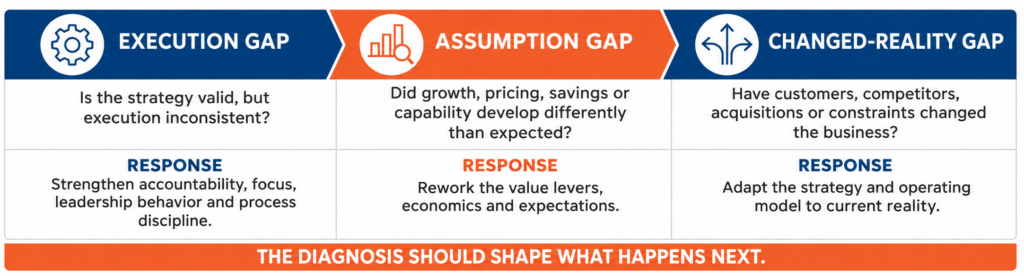
When performance falls below expectations, it is tempting to conclude that the organization simply needs to execute harder. A better reset identifies what kind of gap actually exists:
- Execution gap. The strategy remains valid, but accountability, focus, leadership behavior or process discipline must improve.
- Assumption gap. Growth, pricing, savings, product launches, cultural change or leadership capacity did not develop as expected.
- Changed-reality gap. Competitors entered, customer demand shifted, an acquisition changed the operating model or growth created a new bottleneck.
Those conditions require different responses. Greater urgency will not correct a flawed assumption, and a new strategy will not compensate for weak execution. The diagnosis should shape what happens next.
Reset Strategic Priorities for the Remaining Hold Period
Once current reality is understood, the organization has to move forward. Mid-hold should clarify the new big rocks: the small number of priorities that matter most for the remainder of the hold.
The reset should force explicit choices:
- What deserves more resources?
- What should continue?
- What should be paused?
- What should stop?
Projects accumulate, metrics linger and initiatives continue consuming time after their strategic relevance has declined. Every priority consumes management capacity, so carrying yesterday’s priorities forward has a cost. Stopping work can be one of the clearest signals that the reset is real.
The reset should also reassess investments that were previously deferred. After several years of operating evidence, capital or capability that once seemed premature may now be necessary.
A credible refreshed plan should leave the company with:
- A small number of agreed priorities and a credible economic expectation for each.
- Clear ownership, resources and capital decisions.
- Explicit agreement about what will stop.
- A management cadence that quickly exposes whether the new plan is working.
- Clear direction for leaders throughout the organization about where attention should go.
Management must confront execution gaps. Ownership should also examine whether it provided the consistency, capital, resources and leadership support required to execute the plan. The reset should assess the value creation system both sides have built together.
Rebuild Alignment Between Sponsors and Management
The human side of a reset is often harder than the analytical side. The process works best when the sponsor and management team stand on the same side of the problem.
That requires a common source of truth, an honest acknowledgment of the gaps and agreement on where the organization needs to go. The discussion should be direct:
- What did we expect?
- What happened?
- What do we know now that we did not know then?
- What has to change from here?
A reset can create instability if every reassessment produces another wave of priorities, organizational changes or shifting expectations. Leaders should distinguish between changes required to restore momentum and change for its own sake. The objective is renewed clarity around a credible direction that people can execute.
Once agreement is reached, the refreshed priorities should remain visible in operating reviews, resource decisions, capital allocation, problem-solving, and leadership attention. Accountability should apply to both results and the process used to achieve them. Occasional success through heroics is not the same as durable operating capability. The objective is repeatable execution.
Use the Remaining Runway to Act
Mid-hold is valuable because the sponsor and management team have enough evidence to understand the business more deeply than they could at close, and there is still enough runway to make consequential changes. A new leader still has time to establish credibility and deliver results. Capital has time to create value. Capability has time to develop. Revised priorities have time to generate momentum before exit.
Within the Value Creation by Design lifecycle, the first 100 days begin translating the investment thesis into an operating system. Mid-hold is where that thesis and the emerging operating system should be tested against what the business has become. The question is whether ownership and management will use what they have learned while there is still time to act.
If your portfolio company is approaching mid-hold, connect with a member of the NEXT LEVEL Partners leadership team to compare perspectives and discuss whether the current value creation plan still reflects the opportunity ahead.
