
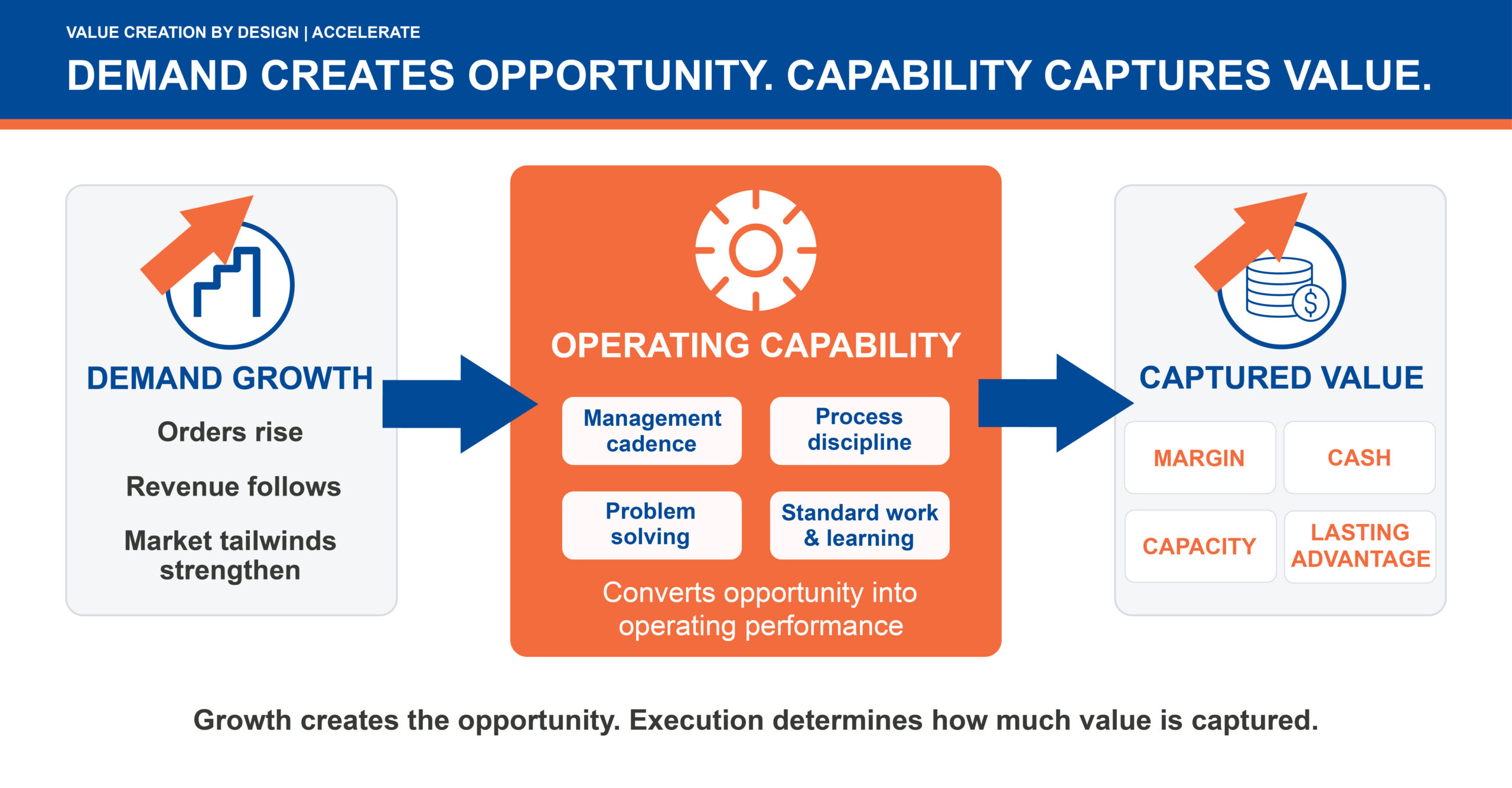
Rapid demand growth can make a strategy look successful before the operating results fully support it. Orders rise, revenue follows, and the market appears to validate the investment thesis. The harder test is whether the business can convert that demand into margin, cash, capacity, and lasting advantage.
One industrial company serving a rapidly expanding market experienced this pattern. Demand accelerated sharply, yet stronger orders did not immediately produce stronger profitability. Pricing and execution challenges emerged as the business scaled.
The example raises a question that applies to any company facing a strong market tailwind: Does the business have the operating capability to capture the opportunity in front of it?
Growth Creates Opportunity and Execution Captures Value
Strong demand can improve the outlook for almost any strategy. It can also expose operating weaknesses quickly. As volume increases, pressure spreads across the business system:
- Demand visibility. Forecasts and demand signals must become more reliable.
- Supply and capacity. Suppliers, equipment, labor, and internal processes must keep pace.
- Quality and flow. Rework, weak handoffs, and bottlenecks become more expensive.
- Management cadence. Leaders need to see emerging constraints early enough to respond.
A business can have the market moving strongly in its favor and still leave substantial economic value uncaptured. Leadership has to translate demand into operating performance. That translation is the work of value creation.
Operational Excellence Belongs in the Value Creation Strategy
Operational excellence often enters the conversation after growth targets, commercial plans, and capital requirements have been established. Leadership then looks to Lean, productivity, working capital, or continuous improvement to help deliver the expected results.
Operating capability belongs earlier in the strategy. Management cadence, process discipline, problem solving, production systems, and employee capability determine whether the company can:
- Shorten customer lead times and introduce products faster
- Increase capacity without losing control of quality or delivery
- Improve working capital and supplier performance
- Integrate acquisitions and scale the organization effectively
A value creation strategy should define where the company intends to go and the capabilities the organization must develop to get there.
Can the Operating System Support Rapid Growth
A useful question for any business pursuing an ambitious growth plan is: If demand doubled tomorrow, would the operating system convert that demand into value, or would growth expose what is already struggling?
Answering that question requires leadership to look beneath the revenue forecast and test the operating assumptions supporting it:
- Process capacity. Can current processes handle additional volume while maintaining quality and service?
- Where will the next bottleneck appear, and can suppliers keep pace?
- Will inventory and working capital grow faster than revenue?
- Can new employees be trained quickly and make decisions at the right level?
- Will management routines surface problems before customers and financial performance are affected?
Poor scaling can consume cash and capital even as revenue grows. Inventory builds, expedited freight increases, capacity is added too early, and rework expands. A growth forecast describes the expected economic outcome. The operating system has to produce it.
Design the Future State Before Scaling the Current State
A common response to rapid growth is to multiply what already exists. More demand leads to more people, equipment, shifts, supervisors, and space. When weaknesses are embedded in the current operation, that approach scales them too.
A business-system approach starts by asking how the company should operate at the future volume. Leaders can then determine:
- Which work should be eliminated and where flow must improve
- Which constraints should be addressed before capital is added
- Which processes need stronger standardization and training
- Which decisions should move closer to the work
- How technology, suppliers, and management routines must evolve
This work can change the economics of the growth plan. Productivity may release capacity before another piece of equipment is purchased. Better flow may reduce the space required for expansion. Standard work can shorten the learning curve for new employees. Stronger problem solving helps teams address constraints before they threaten customer performance.
Build Operating Capability Before Demand Requires It
No leadership team can predict the future precisely. Markets move, technologies change, supply chains break, acquisitions become available, and new demand emerges. Organizational readiness has value even when the next application of that capability is unknown.
Management cadence matters before a crisis exposes weak visibility. Problem-solving capability matters before the next constraint appears. Standard work creates value before a hiring wave begins. Process discipline and employee development matter before additional volume puts more pressure on the system.
Together, those capabilities create strategic optionality. A company with stronger problem solving, faster learning, greater operating visibility, and disciplined execution has more ways to respond when conditions change. Leadership may not know where the next source of value will appear, but it can build the capability to act when opportunity arrives.
Distributed Problem Solving Supports Scalable Growth
Scalable growth requires an operating philosophy in which employees identify poor processes and continually improve the work. Senior leaders cannot personally solve every problem created by greater volume and complexity. Organizations that depend on escalation eventually make leadership the constraint.
A stronger operating system distributes problem-solving capability throughout the company. Employees closest to the work learn to recognize abnormalities, understand processes, test countermeasures, and improve performance. Leaders establish priorities, provide coaching, and create the management cadence that supports the work.
- Kaizen builds learning and improvement through focused action.
- Daily management creates visibility and timely response.
- Standard work provides a baseline for recognizing abnormalities.
- Structured problem solving helps teams understand causes and prevent recurrence.
Over time, more people become capable of improving the business. The organization can remove constraints faster, protect customer performance, release capacity, and respond to growth without routing every issue through senior leadership.
Business System Principles Transfer Across Industries
Business-system principles can transfer from one complex operating environment to another. Products, customers, and operating conditions may differ, but the underlying disciplines remain relevant.
Business-system principles transfer when the practices are adapted to the work. Effective systems make problems visible, connect daily work to strategic priorities, establish accountability, develop problem-solving capability, and turn successful changes into standard practice.
A hospital operates differently from an aerospace manufacturer. A bank faces different constraints than a food producer. Technology companies, distributors, hospitality organizations, and manufacturers each need practices suited to their customers, economics, regulations, and work. They still rely on systems and processes through which information moves, decisions are made, resources are consumed, and value is created.
Experienced Practitioners carry the principles from one environment to another and adapt the practices to the situation in front of them. Copying another company’s production system rarely creates the same capability. Understanding why the system works provides a stronger foundation for building one that fits the business.
From Continuous Improvement Activity to a Business System
Many organizations already conduct Kaizen events, reduce inventory, pursue productivity projects, create dashboards, establish standard work, and address recurring problems. Those efforts can produce meaningful results.
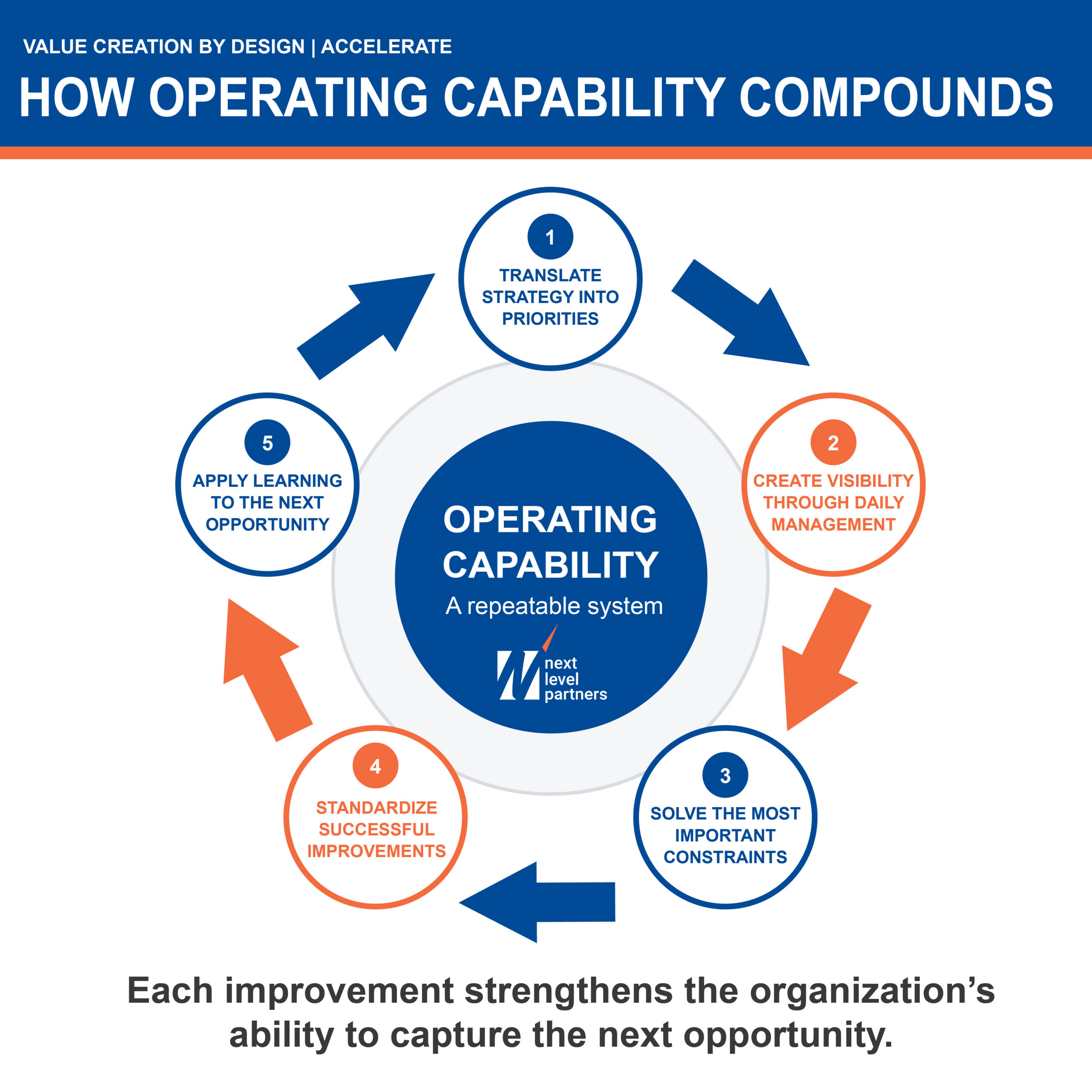
A business-system approach connects them into a repeatable way of running and improving the enterprise:
- Leadership translates strategy into operating priorities.
- Management routines create visibility and accountability.
- Teams work through causes and focus resources on the most important constraints.
- Successful changes become the new standardand create a base for further learning.
The capability compounds. The next constraint benefits from what the organization learned solving the previous one. The next capacity expansion incorporates lessons from the last. The next acquisition benefits from operating disciplines already embedded in the company.
Over time, that capability can support faster growth capture, lower capital intensity, stronger margins, better cash conversion, and more reliable execution of strategic priorities. Operational excellence reaches strategic significance when the company develops a system for repeatedly converting opportunity into performance.
Building an Operating System for Sustainable Growth
The lasting lesson in any fast-growth case sits underneath the growth curve. Market demand creates opportunity. Strategy, technology, capital, and leadership position the company to pursue it. The operating system connects those choices to execution through management cadence, process discipline, employee problem solving, Kaizen, and continuous learning.
That connection is central to the Accelerate stage of Value Creation by Design. Leaders reassess whether the operating plan still reflects current reality, identify the capabilities the next phase requires, and build them before constraints force the issue.
If demand doubled tomorrow, would your operating system convert that demand into value, or would growth expose what is already struggling? The answer says a great deal about how deeply operating capability has been designed into the value creation strategy. Have a question, perspective, or growth challenge your organization is working through? Reach out, our leadership team welcomes the opportunity to compare perspectives and discuss what your operating system may need to capture the next phase of value.