
The data room tells you what a business has reported. It does not always tell you what is happening inside the operation.
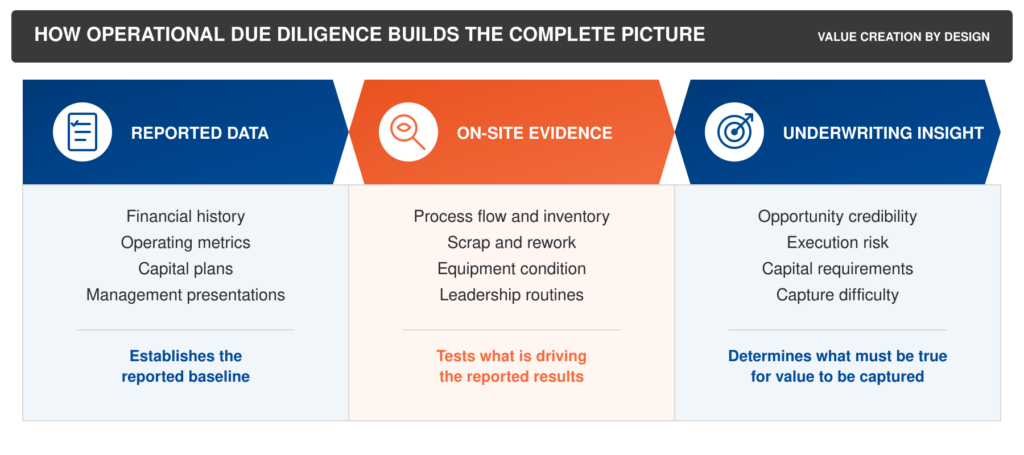
Financial history, operating metrics, customer data, capital plans, and management presentations are all necessary parts of due diligence. Operational due diligence connects those inputs to what is driving the results, whether the investment case is realistic, and what it will take to improve performance after close.
The work should answer two questions: How much opportunity exists, and how difficult will it be to capture? Both belong in the underwriting. A large opportunity means little if realizing it requires leadership capacity, capital, or operating discipline the business does not have.
Private Equity Due Diligence Starts With the Operating Story
Revenue, margin, labor cost, scrap, rework, inventory, delivery, quality, and capital spending establish important trends. They also point to the areas where the investment case assumes future improvement. The next question is whether those measures reflect the economic reality of the business.
A metric can be technically accurate and still give an incomplete picture. Favorable labor efficiency can coexist with poor flow and excessive work-in-process inventory. A low scrap variance can conceal a high absolute level of scrap. Inventory may look reasonable in aggregate even when the mix includes obsolete material, slow-moving stock, or work sitting between operations.
Understanding what sits behind the reported data requires looking at the operation itself.
What an Operational Due Diligence Site Visit Can Reveal
A site visit helps the diligence team investigate the gaps between what has been reported and what can be observed firsthand.
- Performance visibility. Are performance boards current, and do daily routines support the performance story management has presented?
- Flow and waste. Is inventory moving through the process? Are work-in-process and scrap collecting between operations?
- Asset condition. Does the equipment appear well maintained, and is the capital plan consistent with what is visible on the floor?
Those observations do not prove a conclusion, but they show where to ask better questions. A stale performance board may warrant a closer look at the management cadence. Excess work-in-process may point to batch sizes, scheduling practices, demand signals, or local efficiency targets. Equipment deterioration may require a closer review of the capital plan and maintenance strategy.
Conversations with leaders and operators add another layer. Experienced Practitioners listen for how clearly people explain the work, whether leaders describe the same priorities, and whether their answers align with the operating evidence. The conclusions still need to be tested against the data.
When Waste Has Already Been Built Into the Baseline
In one operation, reported scrap cost appeared relatively low and the variance to standard did not look especially concerning. Full scrap bins on the floor led to additional analysis, which showed that expected scrap of roughly 8% to 10% had already been embedded in the standard cost.
The organization had normalized an expensive operating condition. The opportunity was not in bringing performance back to standard, but in addressing the startup and changeover losses already accepted as normal. A low variance does not always mean waste is low; sometimes the waste is built into the expectation.
When Efficiency Works Against the Economics
At another operation, the front end of the process appeared highly productive. Operators were busy, material was moving, and efficiency measures looked respectable. Farther downstream, finished work had been shrink-wrapped, placed into racks, and left there for weeks or months before the next operation needed it.
The business was rewarding local efficiency while overproducing, tying up cash, increasing handling, consuming space, and delaying shipments. When efficiency rises while inventory rises and cash conversion falls, the diligence team needs to understand what the metric is rewarding before accepting projected improvements in working capital, productivity, throughput, or margin.
Turning Operational Findings Into a Credible Value Estimate
Observations become useful to a sponsor when they can be connected to a credible economic estimate grounded in the company’s own data. Scrap opportunities should begin with reported scrap dollars. Labor productivity should begin with the actual labor base. Working-capital estimates should begin with reported inventory and the conditions that created it.
Practitioners can then apply reasonable improvement ranges informed by operating experience across four areas:
- Direct cost and quality. Labor productivity, scrap, material loss, and rework.
- Flow and asset performance. Equipment uptime, throughput, planning, and scheduling.
- Inventory and working capital.
- Operating expense. Freight, parcel contracts, MRO purchasing, safety supplies, and other selected indirect costs.
Indirect savings can be meaningful, particularly when a sponsor can use purchasing power across the portfolio. The larger opportunities, however, are often closer to the core economics of the business, where labor, material, reliability, throughput, inventory, cash generation, and EBITDA intersect.
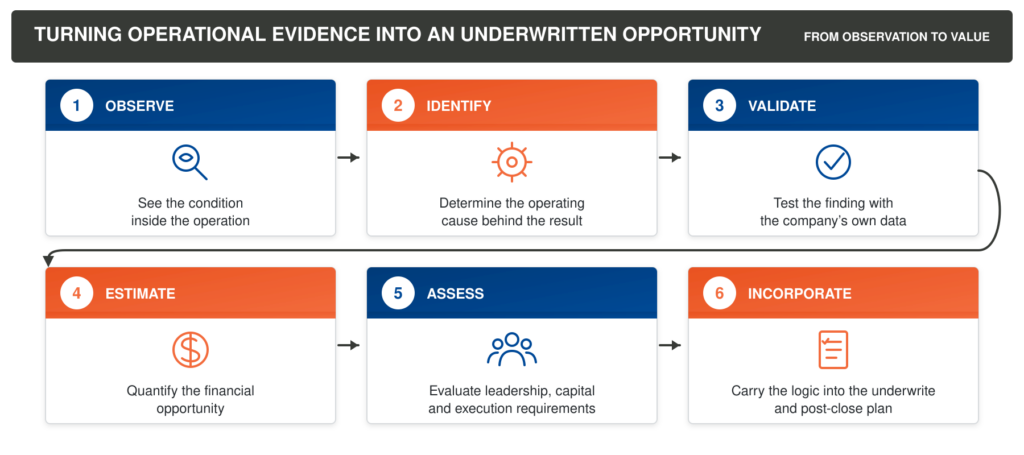
The estimate should be transparent enough for the sponsor to understand the assumptions, adjust the case conservatively, and carry the logic into the post-close plan. If the people responsible for delivering the opportunity cannot understand how it was built, it has limited value as an execution target.
Operational Improvement Potential Depends on the Starting Point
Not every business has the same improvement runway. Some companies have controlled processes, current metrics, strong leadership routines, and years of structured continuous improvement. The obvious opportunities may already be gone, which is a useful diligence conclusion even when it produces a smaller savings estimate.
A company with little history of structured Lean or kaizen activity may have meaningful opportunities in productivity, flow, quality, and working capital. A mature operation may require a different value-creation thesis. The estimate should reflect the condition of the business, not a generic benchmark.
Assessing Execution Risk Before Close
Two businesses can show similar modeled EBITDA upside and require very different levels of effort to achieve it. One may have aligned leaders, disciplined routines, well-maintained assets, and experience with structured improvement. Another may have weak operating discipline, deferred maintenance, inconsistent problem solving, or leadership capacity that has not scaled with the business.
The dollar opportunity may look similar, but the timing, probability, capital requirement, and organizational effort may not. Three areas help reveal that difference:
- Management cadence. Do leaders identify causes, assign ownership, and follow actions through to closure, or does the operating review function mainly as a reporting ritual?
- Command of the business. Do functional leaders understand the quality, inventory, delivery, productivity, uptime, and constraint measures that drive their results?
- Strategic alignment. Do leaders understand and believe the assumptions behind the growth plan, and can they explain what will cause future performance to differ from historical results?
The relationship between commercial and operations leadership can be especially revealing. Persistent friction may later appear as forecast instability, schedule disruption, excessive inventory, customer-service problems, or missed commitments. Tenure and turnover also matter: frequent leadership changes can disrupt continuity, while a long-tenured team may have become comfortable with practices that have gone unchallenged.
An aligned team may be ready to move quickly. Another may need stronger cross-functional routines, coaching, operating support, or selected changes in responsibility before the value-creation plan gains traction.
Capital Requirements Change the Value Creation Equation
Even a capable leadership team can be constrained by an asset base that has been starved of investment. Smaller or family-owned businesses may have aging equipment, chronic unplanned downtime, break-fix maintenance, inadequate spare-parts strategies, long changeover times, deferred facility maintenance, or processes dependent on manual workarounds.
Those conditions change the economics of improvement. A productivity opportunity looks different when capturing it requires significant equipment replacement. An uptime assumption looks different when the maintenance system remains reactive.
Operating upside cannot be evaluated separately from the capital required to achieve it. The diligence team needs to determine whether the planned capital envelope is sufficient and where additional investment may be necessary.
What Sponsors Should Know Before Close
A sponsor should come away from operational diligence with a quantified view of potential improvement and clear answers to four broader questions:
Is the operating story believable?
Do the conditions observed support the strategic narrative and the assumptions behind the investment thesis?
Is the value-creation opportunity real?
Are the opportunities grounded in company data and actual operating conditions?
How difficult will the value be to capture?
What leadership, capability, capital, and operating-system changes will be required?
Can this business win?
Does the company have a credible path to stronger performance, with execution risks understood well enough to support the investment decision?
Answering those questions requires the diligence team to connect the data room, site visit, leadership team, physical assets, and assumptions in the model into one view of the business.
That is the role of operational diligence in the Underwrite stage of the Value Creation by Design lifecycle: establish what must be true for the modeled value to be captured and whether the opportunity is credible, executable, and worth pursuing.
If you are evaluating a platform or add-on and want to test the operating assumptions behind the investment case, reach out and a member of our Leadership team will get in touch with you. We welcome the opportunity to compare perspectives on where value may exist and what it will take to capture it.